
Cultivating art, conservation, and food security through Ficus bonsai and community innovation in the Philippines
Abstract
Urbanization in Metro Manila has significantly reduced natural habitats, posing challenges to biodiversity conservation, particularly for birds that rely on trees and diverse vegetation. Taguig City, one of the fastest-growing urban centers in the Philippines, exemplifies this tension between development and nature. This journal-type article documents observations of urban flora and forest birds within a single private compound of approximately 10,000 square meters in Taguig City. Despite the city’s limited green spaces, the compound supports a remarkably diverse assemblage of fruit trees, native and exotic plants, medicinal herbs, and grasses, which in turn sustain a small but stable community of urban forest birds. By describing the flora first—its structure, diversity, and ecological roles—this article provides context for understanding bird presence and behavior. Regularly observed bird species include the Yellow-vented Bulbul (Pycnonotus goiavier), Pied Fantail (Rhipidura javanica), Brown Shrike (Lanius cristatus), Eurasian Tree Sparrow (Passer montanus), Large-billed Crow (Corvus macrorhynchos), Olive-backed Sunbird (Cinnyris jugularis), Coppersmith Barbet (Psilopogon haemacephalus), and Red-keeled Flowerpecker (Dicaeum australe). The observations highlight the importance of even small, fragmented green spaces in urban landscapes and underscore the role of private lands in conserving urban biodiversity in Taguig City.
Keywords
Urban ecology, urban birds, Taguig City, green spaces, urban flora, Philippines, avian diversity, aves
- Introduction
Cities are often perceived as biological deserts, dominated by concrete, steel, and human activity. However, urban environments can still support pockets of biodiversity, particularly when green spaces are present. Urban ecology has increasingly shown that birds, due to their mobility and adaptability, are among the most visible indicators of ecological health in cities. In the Philippines, where rapid urbanization frequently occurs at the expense of natural habitats, understanding how birds persist in cities is both scientifically and socially important.
Taguig City, located in the southeastern part of Metro Manila, has undergone dramatic transformation over the past few decades. Once characterized by agricultural lands and wetlands, it is now known for high-density residential areas, business districts, and major infrastructure projects. Public green spaces in Taguig are limited and unevenly distributed, making private gardens, compounds, and institutional grounds increasingly important as refuges for urban wildlife.
This article presents a journal-type narrative based on repeated observations within a single compound of about 10,000 square meters in Taguig City. Rather than focusing solely on birds, the discussion begins with the urban flora, recognizing that vegetation forms the foundation of avian habitat. The birds observed are then described in relation to the plant community that supports them. Through this localized case study, the article aims to illustrate broader themes in urban biodiversity conservation.
- Urban Green Spaces in Taguig City
Green spaces in Taguig City are scarce relative to the intensity of urban development. While there are parks and landscaped areas, many are ornamental rather than ecologically functional, often dominated by a few non-native species and manicured lawns. Trees are frequently removed to make way for roads, buildings, and utilities, resulting in fragmented habitats.
In this context, private compounds with mixed vegetation become critical ecological islands. Although small in comparison to natural forests, such spaces can provide food, nesting sites, shelter, and stopover points for birds. The compound discussed in this article functions as a semi-urban forest patch, combining fruit trees, ornamental plants, crops, and native species. Its size—approximately one hectare—allows for vertical and horizontal vegetation structure, which is essential for supporting diverse bird species.
- Urban Flora Observed in the Compound
3.1 Tree Layer and Fruit-Bearing Species
The most prominent feature of the compound is its diverse collection of trees, many of which are fruit-bearing. These include avocado, mango, chico, duhat, santol, mulberry, longgan, rambutan, pomelo, guava, atis, pomegranate, chestnut, grapes, and sugarcane grown in patches. Exotic temperate species such as Fuji apple, Japanese persimmon, Asian pear, Ochiyo cherry, Honeycrisp kumquat, Meyer lemon, and Thailand jujube coexist with tropical fruit trees, creating an unusual but productive canopy.
Several species of Ficus are present, including Ficus variegata, red balete, golden balete, Ficus benjamina, Iraqi figs, tibig, and hauili. These fig trees are particularly important ecologically, as they provide year-round or seasonal fruits that are attractive to birds. The presence of bagalunga, talisay, ipil, ipil-ipil, and MacArthur’s palm adds further structural diversity to the upper and mid-canopy layers.
3.2 Understory Plants, Shrubs, and Medicinal Species
Beneath the trees lies a rich understory of shrubs, herbs, and medicinal plants. These include lagundi, moringa, noni (Morinda citrifolia), medinilla, pakpak lawin babae, insulin plant, oregano, musk basil, tawa-tawa, pancit-pancitan, kulitis, paragis grass, and Turkey cherry. Many of these plants flower or fruit at different times of the year, providing continuous resources for insects and nectar-feeding birds.
Ornamental and functional shrubs such as kalamansi, lemongrass, and golden shower add both aesthetic and ecological value. The diversity of flowering plants supports insect populations, which in turn attract insectivorous birds.
3.3 Ground Cover, Crops, and Grasses
The ground layer consists of mixed crops and grasses, including sweet potato, kangkong, tomato, okra, eggplant, gabi, ginger, turmeric, napier grass, carabao grass, and sugarcane. These plants contribute to soil cover, moisture retention, and invertebrate diversity. While not directly used by birds for feeding in all cases, they indirectly support avian life by sustaining insects and small organisms.
The presence of both cultivated and semi-wild vegetation creates a mosaic of microhabitats. This complexity is rare in urban Taguig and is a key reason for the regular presence of birds within the compound.
- Observed Urban Forest Birds
4.1 Yellow-vented Bulbul (Pycnonotus goiavier)
The Yellow-vented Bulbul is one of the most consistently observed species in the compound. Highly adaptable, it thrives in urban and semi-urban environments. It feeds on fruits such as mulberry, duhat, and figs, as well as insects found among foliage. Its loud calls and active movement make it a conspicuous presence, often acting as an indicator of fruit availability.
4.2 Pied Fantail (Rhipidura javanica)
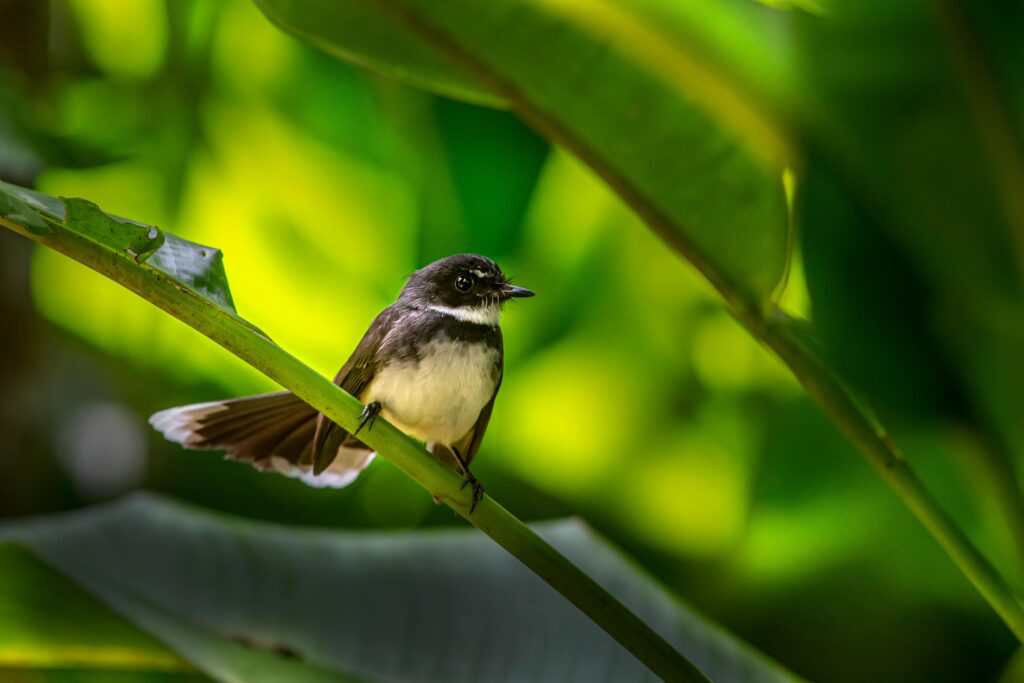
The Pied Fantail is frequently seen flitting through the understory and lower canopy, actively catching insects mid-air. Its presence reflects the healthy insect population supported by diverse vegetation. The species often follows human activity, taking advantage of disturbed insects, yet it still relies on trees and shrubs for perching and nesting.
4.3 Brown Shrike (Lanius cristatus)
The Brown Shrike is observed seasonally, often perched on exposed branches or wires near open areas. As a predatory bird, it feeds on insects and small vertebrates. Its use of both trees and open spaces highlights the importance of habitat heterogeneity within the compound.
4.4 Eurasian Tree Sparrow (Passer montanus)
Sparrows are common urban birds, frequently associated with human habitation. In the compound, they forage on seeds, insects, and food scraps, while also using trees for roosting. Their presence demonstrates how traditional urban species can coexist with more forest-associated birds when vegetation is available.
4.5 Large-billed Crow (Corvus macrorhynchos)
The Large-billed Crow is an occasional but regular visitor. Highly intelligent and adaptable, it uses tall trees such as talisay and Ficus species for perching and observation. While often viewed negatively in urban settings, crows play a role as scavengers and are part of the natural urban avifauna.
4.6 Olive-backed Sunbird (Cinnyris jugularis)
The Olive-backed Sunbird is closely associated with flowering plants. It is frequently seen feeding on nectar from golden shower, kalamansi blossoms, and other flowering species. Its presence underscores the importance of maintaining flowering plants in urban landscapes.
4.7 Coppersmith Barbet (Psilopogon haemacephalus)
The distinctive call of the Coppersmith Barbet is often heard before the bird is seen. It feeds on fruits, particularly figs, and uses tree cavities for nesting. Its regular presence suggests that the compound provides sufficient tree maturity and fruit resources.
4.8 Red-keeled Flowerpecker (Dicaeum australe)
Small and often overlooked, the Red-keeled Flowerpecker is an important pollinator and seed disperser. It feeds on small fruits and nectar, particularly from fig trees and flowering shrubs. Its occurrence indicates a relatively intact urban micro-ecosystem.
- Discussion: Flora–Bird Interactions in an Urban Setting
The observations from this Taguig City compound highlight the tight relationship between plant diversity and bird presence. Fruit trees attract frugivores, flowering plants support nectarivores, and dense vegetation sustains insects for insectivorous species. The layered structure of the vegetation—from ground cover to canopy—creates niches that different bird species can exploit.
In a city where large green spaces are limited, such compounds function as stepping stones or refuges. Birds may move between these patches, contributing to urban ecological connectivity. The mixture of native and exotic plant species, while not ideal from a conservation purity standpoint, still provides functional habitat in an otherwise hostile urban matrix.
- Implications for Urban Biodiversity Conservation
This case study suggests that biodiversity conservation in cities like Taguig cannot rely solely on public parks. Private lands, home gardens, and compounds play a crucial role. Encouraging urban residents and institutions to plant diverse trees—especially fruit-bearing and native species—can significantly enhance urban bird diversity.
Urban planning policies should recognize and incentivize the preservation of mature trees and mixed vegetation. Even small-scale actions, when multiplied across the city, can create a network of green spaces that support birds and other wildlife.
- Conclusion
Despite severe limitations in green space, Taguig City still holds potential for urban biodiversity conservation. The 10,000-square-meter compound described in this article demonstrates how diverse urban flora can support a stable community of urban forest birds. By prioritizing vegetation diversity and structural complexity, even private urban spaces can function as ecological refuges.
The continued presence of species such as the Yellow-vented Bulbul, Coppersmith Barbet, and Red-keeled Flowerpecker serves as a reminder that birds will persist where resources exist. Protecting and expanding green spaces—no matter how small—is essential for maintaining urban ecological balance. In rapidly developing cities like Taguig, the future of urban birds may well depend on the choices made at the scale of individual compounds and gardens.
Support Our Research
This research helps protect endangered species. Consider donating to continue our work.